On our return to England on 13 November, we were privileged to hear a performance of Britten's War Requiem sung in Coventry Cathedral. Coventry's medieval cathedral was bombed into a ruin on the night of 14 November, 1940. The magnificent new building, set among the ruins of the old, was completed in 1963, and Britten's requiem was commissioned for its opening. My sister sang in the chorus this November. Near her stood a woman who had also sung in the work, with Britten conducting, in 1963. In the audience were people who lived through the night of 14 November, 1940.
Britten set the requiem mass in Latin, but between the standard movements he set poems by Wilfred Owen, poems written during and about Owen's experiences as a soldier during the first world war. The work is stark and grand and heartrending. I sang in this piece when the Minnesota Orchestra and Saint Paul Chamber Orchestra performed it in 2007. It's beyond me how anyone, having heard this music and text, could contemplate making war.
Britten sets the words dona nobis pacem as a cry in the wilderness. Before the third Agnus Dei the tenor sings the verse of Owen:
The scribes on all the people shove
And bawl allegiance to the state,
But they who love the greater love
Lay down their life; they do not hate.
After the chorus mutters the agnus, the dona nobis pacem is sung by the tenor: the first five notes of the F# major scale followed by the first five notes of the c minor scale dropping back again to f#. Dona nobis is major moving up, pacem is minor, also climbing, but twisted somehow and as painful as beautiful. Takes your breath away. Listen to it.
Last night, we were privileged again to hear, in the York Minster Chapter House, a concert of renaissance English choral music performed by Stile Antico, a group of 13 splendid young singers. The program was centered on a mass by Thomas Tallis (1505-1585). Tallis, and the other composers on the program (William Byrd, Robert White, John Taverner, John Sheppard) lived at a time when official religious practice in England was going back and forth between Catholicism and Anglican protestantism. Up until the 1530s, you got burned for owning the gospels translated into English. In 1585, Margaret Clitherow, who lived in the Shambles in York, was publicly crushed to death for her part in hiding a Jesuit priest.
So when these guys, who were in many cases writing their Latin settings in secret for secret celebrations, set the words dona nobis pacem they must have really been feeling it. Tallis's setting, in rich seven part harmony, lacks the agony of Britten's but is equally quiet. It's scored low in the singers ranges, undulating, and you feel like you're listening to hearts rather than voices.
Friday, 3 December 2010

Wednesday, 1 December 2010
York, Minnesota.
Ever since Thanksgiving, it has been snowing, and we've now accumulated about 10 inches. It's very early for snow here in York where, during a bad winter, they expect less than a month of snowy weather. So people were a bit glum about it when it started. But now there has been so much of it that people are getting quite excited. Every store in Yorkshire has sold out of sledges and Wellington boots, and all day long the youth are climbing up and sliding down the embankments below the walls.
Bus services were curtailed and trains across the county cancelled today as of noon. The public library (where we spent the morning working) shut down, the Minster was empty, the streets devoid of the usual crowds of shoppers and tourists. A good day for a browse in a bookshop, a walk home along the river, and a hot apple crisp for dinner dessert.
 |
| The Ouse from Ousebridge on our walk home |
Bus services were curtailed and trains across the county cancelled today as of noon. The public library (where we spent the morning working) shut down, the Minster was empty, the streets devoid of the usual crowds of shoppers and tourists. A good day for a browse in a bookshop, a walk home along the river, and a hot apple crisp for dinner dessert.
Thursday, 25 November 2010
Thanksgiving on South Bank
Just a quick post to let people at home know that we had a festive time of it on Scott Street. A "loose bird" turkey, stuffing sent by Jessica's mom from the states, Gabby's mashed potatoes, parsnips, Brussels sprouts, various juices, various pies, and eight pints of draft cider were consumed. All over York today, in the picture postcard snow, Yorkshire men and women wished us a happy Thanksgiving, but having Thanksgiving with such a lovely group of people was the real blessing.
 |
Saturday, 20 November 2010
Sloe Time in Yorkshire
Looking for a break, and needing to visit the library on campus, I took a modest bike ride out into the country southwest of York yesterday. The weather was grey, cool and misty but not actually wet. I thought I could ride out as far as Sutton on Derwent (about 7 miles from York) and then loop around to the bike path coming in from Selby, directly south of the city. Along the way, I could visit a few old monuments, and I could let the information my computer has been spitting at me soak in a bit, maybe to the point of making sense.
The countryside around York is slightly rolling to flat and at this time of year it is green with winter wheat or other cover crops contrasting with the dark browns of soil, wet leafless hedges and tree trunks. The architecture of the villages is shown to particular advantage in wet misty weather, the darkened brick and stone setting off delightfully the brightly painted wood trim.
Approaching Sutton upon Derwent, I crossed the river on an ancient single lane stone bridge. There aren't a lot of bridges across the Derwent in this part of Yorkshire, so I suspect that this was an important one in days gone by. The bridge is first recorded there in 1396; earlier than that, there's mention of a ferry.
From the bridge, through the mists, I could make out the Saxon style tower of the church in Sutton which surprised me because I hadn't noticed a church recorded on my OS map. But there is indeed a very fine church, set on a hill overlooking the river, with architectural elements dating from Norman (13th c) and perpendicular (15th c) periods. The various periods are blended here as they are in so many English parish churches resulting in an architecture, harmonious in itself, that could never be built in one time alone. The aging, the age, the ages are essential.
Back on the road home, I came across some hedgerows lush with sloes, a tiny variety of plum. They're too astringent to eat directly off their thorny branches, but the English have learned over the centuries to pick them after the first frost and soak them along with sugar in gin or vodka for six to twelve months, producing a sweet concoction called sloe gin. So I stopped and picked a saddlebag full. They're now resting comfortably at the bottom of a jar, relinquishing, I hope, whatever of the landscape and summer of 2010 they were able to capture, into a liter of vodka. But I'll have to wait. You can't hurry sloe gin any more than you can hurry the building of an English parish church.
I returned home tired and refreshed. I'd ridden about 25 miles in two and a half hours. I'd had a few ideas about my work that I never could have had sitting in front of the laptop, and I had the beginnings of next summer's sloe gin. My computer had, in the meantime, performed many billions of calculations. Good for an afternoon of analysis and reflection. Slow time.
The countryside around York is slightly rolling to flat and at this time of year it is green with winter wheat or other cover crops contrasting with the dark browns of soil, wet leafless hedges and tree trunks. The architecture of the villages is shown to particular advantage in wet misty weather, the darkened brick and stone setting off delightfully the brightly painted wood trim.
 |
| "Class II historic structure" An elegant bridge over the Derwent |
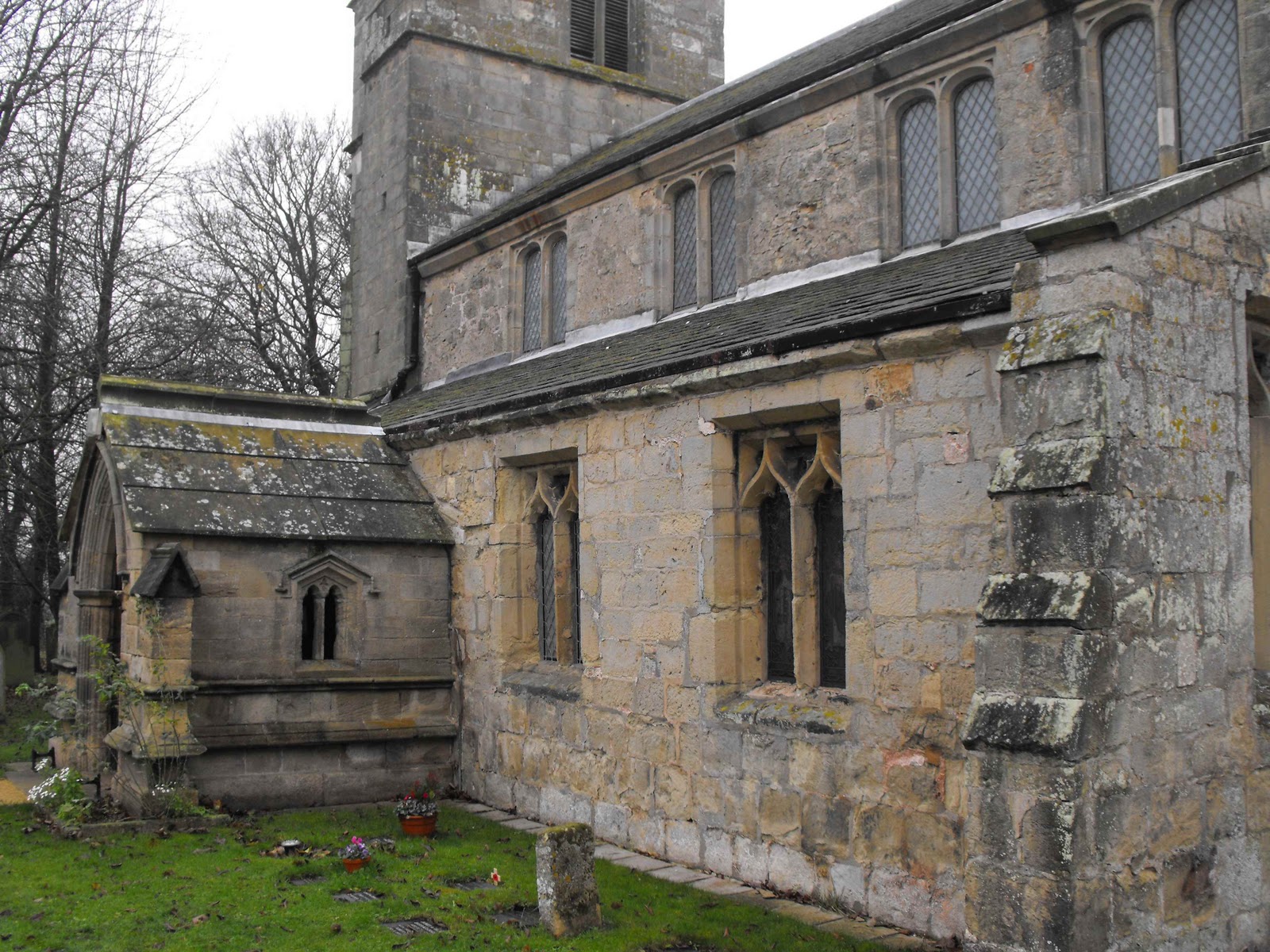 |
| Sutton upon Derwent, Saint Michael's Church. Three distinct architectural styles are represented here. |
 |
| Sloes |
I returned home tired and refreshed. I'd ridden about 25 miles in two and a half hours. I'd had a few ideas about my work that I never could have had sitting in front of the laptop, and I had the beginnings of next summer's sloe gin. My computer had, in the meantime, performed many billions of calculations. Good for an afternoon of analysis and reflection. Slow time.
Wednesday, 17 November 2010
Artist's Copy: Jana Anderson
 |
| A small digital image on the internet! |
The works of art I’ve studied and admire are right here in front of me at places such as the Tate Modern, Tate Britain, and National Gallery. Actually sitting before pieces of art by famous artists such as Blake, Turner, Constable, and Picasso, I feel like I can get to know them in more detail – how the artist worked, what the color palette looks like in person, and I can actually experience the size and power of each piece. Some of the paintings are provocative and ever changing in ways one could never discover by viewing a small digital image on the Internet. They were meant to be experienced. They were meant to be looked at. I could spend days in these London museums and keep discovering new things about these works of art. They grow and change with the viewer, and I feel privileged to be one of the thousands of visitors to pass through and take the time to truly look.
Since I'm visiting these museums as a tourist, I feel obligated to experience everything. Taking it all in at an appropriate pace is impossible, but I find myself rushing through to see as much as I can. When I did take a little extra time to sit in front of some of these works of art and make copies, both my eyes and mind slowed down and I was able to more carefully observe holistically. Although I felt like a rushed tourist in London, I did make a copy of a Turner drawing and one of a Picasso painting. It would probably be stimulating to take more than half an hour to do this, but even with the quick sketches I did, I feel like I've begun to really know these works of art. I think art history is half reading history and half looking at and taking in the power of an image. At times, observation might be worth even more than half. It allows for an understanding of art through the eyes of the artist, not the eyes of the art historian or researcher.
 |
| Copy or Thievery? |
More observations and reflections on the York experience by Jana are available on her own blog, found here.
Tuesday, 16 November 2010
York in November
 |
| Taken at 3pm GMT. |
Inside the Top of the Chapter House
 |
| Chapterhouse Roof Walkway |
To get to the roof, we had to ascend a narrow spiral staircase. At the top of this, we passed through the world’s tiniest door and emerged onto the ledge of the chapter house roof. It was raining, the fence around the roof only came up to about knee height, and the wind was blowing strongly, yet despite all that, being on the roof was more magnificent than frightening. Carefully, we made our way inside where we were met by a labyrinth of wooden beams stretching higher up than we could see. Honestly, the beams didn’t appear to be in any particular order or place, just a mess of wood jutting in different directions, and it seemed only by sheer luck that the roof was holding together.
 |
| 600 year old oak trusswork: looking straight up! |
--Jessica Churchill
 |
| Chapter House from outside. Scaffold levels are at least 10 feet apart. We went inside the roof. |
 |
| From the inside looking up. We were above this. |
Subscribe to:
Posts (Atom)